
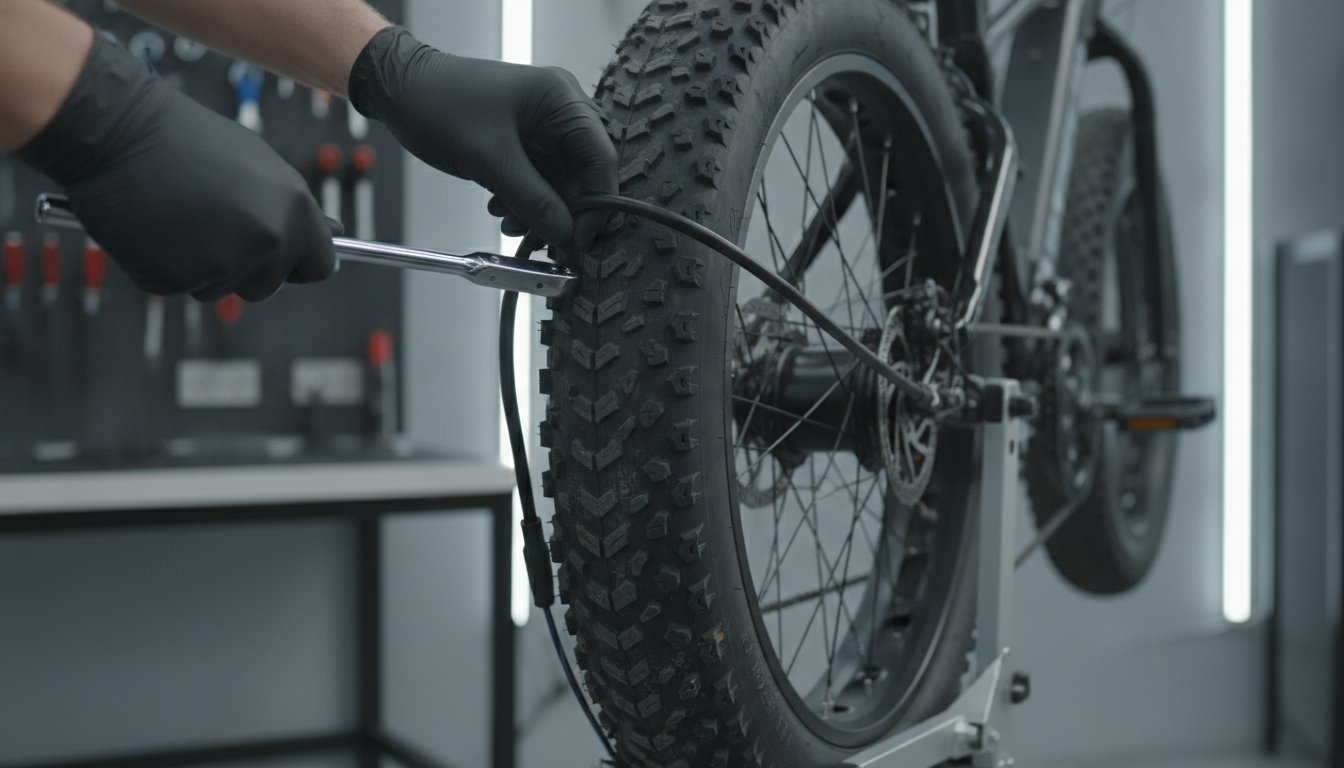
Replacing an e-bike tire isn’t just a standard bike repair; it’s a high-stakes maintenance task where one wrong tug on a hub motor cable can turn a simple tube swap into a costly electrical disaster. You’re right to feel a bit nervous when staring down a 70-pound fat tire bike and a complex web of wiring. It’s completely normal to worry about misaligning the motor or failing to find the correct tire pressure for these heavier machines. This guide gives you the confidence to handle your own maintenance while knowing exactly when to seek professional e-bike brake repair from Tartarian E-bikes to ensure your safety systems remain as sharp as your new tread.
We’ll walk through the specific steps to disconnect motor wiring safely, choose the best puncture-resistant rubber for 2026, and re-align your wheel perfectly every time. You’ll learn how to manage heavy fat tires without the struggle and identify the exact moment your tread becomes a safety risk. By the end, you’ll treat your tires as a high-precision e-mobility component rather than just a piece of rubber, ensuring your ride stays smooth and your motor stays protected.
Key Takeaways
- Learn to identify subtle Tread Wear Indicators and internal casing stress before they lead to a dangerous mid-ride tire failure.
- Master the safety protocols for hub motor maintenance, including the “Golden Rule” of battery disconnection and the use of specialized 18mm/19mm wrenches.
- Compare puncture protection technologies like Kevlar and Tannus inserts to choose the best rubber for high-performance models like the Himiway Zebra.
- Navigate the technical steps of rear wheel removal by preparing your drivetrain and choosing between a handlebar jack or a heavy-duty e-bike stand.
- Verify your post-installation safety with a bedding-in period and a precise alignment check to determine if you need professional e-bike brake repair Las Cruces.
Recognizing the Signs: When is it Time for an E-Bike Tire Replacement?
Identifying a worn-out tire is the first step toward a safe ride. E-bikes aren’t just heavy bicycles; they are high-torque machines that put immense pressure on their rubber. Most high-performance e-bike tires include a Tread Wear Indicator (TWI). This is usually a small circular indentation in the tread pattern. When the surrounding rubber wears down to the level of that dot, your tire’s structural integrity is officially compromised. You shouldn’t wait for the tread to disappear completely before taking action.
Visual cues often tell the story of a tire’s life. Look for dry rot or small cracks along the sidewall, which suggest the rubber compounds are breaking down. You might also experience “ghost flats.” These are punctures that seem to happen for no reason. In reality, the internal bicycle tire construction is fraying from the inside out, causing the casing to pinch the tube. If you notice your stopping power feels sluggish even after a professional e-bike brake repair Las Cruces, your tires are likely the weak link in your safety chain.
Mileage benchmarks vary based on your riding style. Commuter models typically require a replacement every 1,500 to 3,000 miles. If you’re riding off-road or on aggressive terrain, expect that window to shrink toward the 1,200-mile mark. Consistent inspections are the only way to stay ahead of a blowout.
The Impact of E-Bike Weight on Tire Longevity
Weight is the enemy of rubber. E-bikes featuring 750W+ motors, like the Himiway Zebra or Mokwheel Obsidian, generate massive torque that standard tires simply can’t handle. This force is concentrated on the rear tire contact patch. Every high-torque start from a stoplight effectively “strips” a microscopic layer of rubber. When you add heavy payloads or passengers to a Denago Commute Model 1, the tire deforms under the weight. This constant flexing weakens the sidewalls and accelerates degradation far faster than on a non-electric bike.
Safety Risks of Riding on Balding E-Bike Tires
Safety becomes a major concern when you’re traveling at 20mph or more. Balding tires significantly increase your braking distances, which is a critical risk in traffic. On urban surfaces, models like the Denago City Model 1 rely on deep tread channels to move water. Without them, you risk hydroplaning on even slightly damp roads. Furthermore, thin tread is vulnerable to road debris. A tiny shard of glass that a new tire would deflect will easily penetrate a worn casing. If you’ve recently sought e-bike brake repair Las Cruces to keep your bike responsive, don’t undermine that investment by riding on paper-thin tires that can’t grip the pavement.
The Hub Motor Challenge: Essential Tools and Safety Protocols
Don’t treat your hub motor like a standard bicycle wheel. The rear wheel of a high-powered e-bike is a complex assembly of magnets, copper windings, and high-voltage wiring. The “Golden Rule” of e-bike repair is simple: disconnect the battery before you touch the motor. Even if the bike is turned off, a live battery can still send a surge if a connector is mishandled. Safety starts with a cold system. While you are working on the drivetrain, it is also the perfect time to inspect your pads or consider if you need professional e-bike brake repair Las Cruces to ensure your stopping power matches your motor’s output.
Standard bike tools usually fall short when dealing with 2026 e-mobility standards. You will need a specific set of heavy-duty equipment to manage the job safely. Most hub motors utilize 18mm or 19mm axle nuts, which are significantly larger than the 15mm nuts found on traditional bikes. You will also need heavy-duty tire levers; plastic ones often snap under the tension of a reinforced e-bike tire bead. Finally, a torque wrench is non-negotiable for re-assembly. Over-tightening can crush delicate internal sensors, while under-tightening can cause the axle to spin out of the frame.
Managing the weight of these machines is another hurdle. A fat tire e-bike can weigh between 60 and 90 pounds. A standard consumer-grade bike stand is likely to tip or buckle under this load. If you don’t have a motorcycle-grade lift, it is often safer to work on the ground using a handlebar jack to protect your display and controls from being crushed.
Managing the Electrical Phase Wires
The motor cable is your lifeline, and it is remarkably easy to damage. Start by carefully snipping the zip ties that secure the cable to the frame. Locate the 9-pin motor connector, which is usually found a few inches from the motor hub. Look for the small alignment arrows on both sides of the plug before pulling it apart. Never twist the connector; pull it straight to avoid bending the pins. When you re-install the wheel, always create a “Drip Loop.” This is a small downward curve in the cable that prevents rainwater from following the wire directly into the motor housing. If you find the electrical side of maintenance intimidating, the team at Tartarian E-Bikes can handle the technical heavy lifting for you.
Torque Arms and Washers: The Hidden Hardware
High-torque motors produce enough force to physically rip themselves out of the frame’s dropouts. This is why torque arms are essential. These metal plates lock the axle in place, preventing it from spinning. Pay close attention to the anti-rotation washers. These have a specific “tab” that must sit inside the dropout. A pro tip is to take a high-resolution photo of the washer order before you loosen anything. You won’t find standard quick-releases here; the sheer power of a rear-hub system requires the security of bolted axles and precise hardware alignment to stay safe at high speeds. This alignment is also critical for your rotors, as even a millimeter of offset can necessitate an e-bike brake repair Las Cruces to stop annoying disc rub.
Choosing the Right Rubber: E-Bike Tire Comparison Framework
Not every piece of rubber is built for the weight and speed of a modern electric bike. The most critical factor for 2026 is E-50 certification. This rating ensures the tire is tested for safety at speeds up to 50km/h (31mph). Using a standard bicycle tire on a Class 3 e-bike is a recipe for catastrophic failure. High-speed rotation generates heat that can cause non-rated casings to separate under pressure. When you choose a tire, look for that specific certification mark on the sidewall to ensure your equipment matches your motor’s potential.
Puncture protection is your next priority. You have three primary levels of defense to consider before you head out on the road:
- Kevlar Belts: Lightweight and flexible, these provide a solid barrier against glass and sharp debris without ruining your ride quality or adding excessive weight.
- High-Density Rubber: These tires use a thick layer of specialized rubber (often 3mm to 5mm) to stop thorns and wire before they can reach the inner tube.
- Tannus Armor Inserts: These foam inserts sit between the tire and the tube. They provide nearly 15mm of protection and allow you to “run flat” at low speeds if a puncture does occur.
Don’t ignore the bead construction. While folding beads are popular for weight savings, wire beads are often superior for heavy e-bikes. The rigid wire helps the tire stay seated on the rim under the massive torque of a rear hub motor. If your new tire selection changes the weight of your wheel significantly, it will affect your stopping distance. If you notice your bike isn’t biting into the pavement like it used to after a swap, it might be time for a professional e-bike brake repair Las Cruces to recalibrate your system for the new rubber.
Fat Tires vs. Commuter Tires
Your choice depends entirely on your terrain and goals. 4-inch fat tires, like those on the Himiway Zebra, offer incredible stability and act as a secondary suspension system. They excel in sand and loose gravel because of their massive air volume and low PSI requirements. Conversely, 2.0-inch commuter tires, found on the Denago City Model 1, offer significantly lower rolling resistance. This efficiency can add several miles to your battery range, making them the better choice for long-distance pavement riding where speed and range are the priorities.
Tube Selection and Sealant Options
Your tube is your last line of defense against a long walk home. Standard butyl tubes are fine for casual rides, but heavy-duty thorn-resistant tubes are essential for desert environments like ours. Pre-installing a liquid sealant can save you from future headaches by plugging small holes instantly as you ride. Just ensure your valve type matches your rim. Most e-bikes use the wider Schrader valves common on cars, though some performance models use the slimmer Presta valves. For a deeper dive into selecting and installing the right inner tube for your specific motor setup, our e-bike tube replacement technical guide covers every detail from valve compatibility to sealant application. Maintaining the right pressure prevents pinch flats, which are just as dangerous as a worn-out rotor requiring e-bike brake repair Las Cruces.

Step-by-Step: Replacing Your E-Bike Tire Safely
Preparation is the difference between a successful repair and a broken component. Start by shifting your chain to the smallest cog on the rear cassette. This creates the necessary slack in your drivetrain, allowing the derailleur to move freely as you pull the wheel away from the frame. If you leave the bike in a lower, larger gear, you will find yourself fighting the derailleur spring, which often leads to grease-stained hands and frustrated mistakes.
You must also decide how to stabilize your bike. While a professional heavy-duty e-bike stand is the gold standard, many home mechanics prefer flipping the bike. If you choose the “upside down” method, use a handlebar jack. This tool elevates the front end so you don’t crush your expensive LCD display or hydraulic brake levers. Damaging these parts is a common pitfall that often results in an immediate need for e-bike brake repair Las Cruces before you can even test your new tread.
Removing the Rear Hub Wheel
Loosen the axle nuts with your 18mm or 19mm wrench while supporting the motor’s weight. A rear hub motor can weigh 15 pounds or more; don’t let it drop suddenly and strain the phase wires. Carefully guide the chain off the cogs and slide the wheel out of the dropouts. Pay close attention to the disc brake rotor. It is incredibly easy to bend the rotor against the frame during this step. A warped rotor will cause annoying rubbing and compromise your stopping power, forcing you to seek e-bike brake repair Las Cruces to regain a smooth ride.
Re-Assembly and Connection
Once the new tire is on the rim, use the “soapy water” trick. Rubbing a small amount of dish soap on the tire bead helps the rubber slide into a perfect, even seat as you inflate it. Slide the wheel back into the frame, ensuring the flat edges of the motor axle align perfectly with the dropout slots. If these aren’t perfectly indexed, the motor will eventually spin out and destroy your frame.
Tighten the axle nuts to a specific torque of 35-45Nm. This range provides enough clamping force to handle the motor’s torque without stripping the axle threads. Perform the “Click” test by pushing the motor connector together until you hear and feel a solid connection. If it’s not fully seated, your display will throw an error code. Finally, secure the cable with heat-resistant zip ties, keeping it far away from both the tire and the hot brake rotor. If the process feels overwhelming, book a professional service at Tartarian E-Bikes to ensure your motor and safety systems are correctly re-installed.
Post-Replacement Safety Check and Professional Support
Your repair isn’t finished just because the axle nuts are tight. The first five miles of riding on a new tire constitute a critical “bedding in” period. During this time, you should keep your speed moderate and avoid aggressive cornering. Listen closely for any rhythmic ticking or rubbing sounds. A slight vibration could indicate that the tire bead hasn’t seated perfectly or that a motor cable is brushing against the spokes. If you feel a pulsing sensation when you pull the levers, your disc rotor might have been bumped during the swap, requiring a professional e-bike brake repair Las Cruces to restore your safety.
Testing the motor is equally vital. Engage the throttle or pedal assist at a low level first to ensure power delivery is smooth and silent. If the motor stutters or the display throws a “Communication Error,” you’ll need to revisit that 9-pin connector to ensure it’s fully seated. Don’t ignore these signs; a loose connection can arc and damage the controller. If the bike feels unstable or the motor feels “heavy,” double-check your work immediately. There’s no shame in recognizing when a technical hurdle is beyond your current toolset.
Final Mechanical Inspection
Perform a modified “M-Check” before your first commute. Start at the front wheel and move in an M-shape across the frame to the rear motor. You’ll want to verify four key areas:
- Tire Security: Give the wheel a spin to check for “true.” The tire shouldn’t wobble or hop as it rotates.
- Brake Function: Ensure the pads aren’t dragging. If you hear a “sching-sching” sound, you likely need an e-bike brake repair Las Cruces to realign the caliper.
- Chain Tension: Verify the chain moves smoothly across the smallest cog without jumping.
- PSI Verification: Use a digital gauge to confirm your pressure matches the “Loaded” recommendation on the sidewall. E-bikes require higher pressure than standard bikes to support the battery and motor weight.
Tartarian E-bikes Service Solutions
We understand that not every rider wants to risk handling high-torque hub motors alone. Tartarian E-bikes offers professional assembly and comprehensive safety inspection services to give you total peace of mind. Our team specializes in complex drivetrain issues and precise motor alignments that home tools often can’t achieve. Whether you’re dealing with a stubborn fat tire or a mysterious electrical fault, we provide on-site maintenance and premium parts to keep you on the road. We support the local riding community with expert knowledge, ensuring every 750W machine we service meets the highest safety standards for 2026 and beyond.
Secure Your Ride for the Miles Ahead
You’ve now mastered the technical nuances of e-bike tire maintenance, from identifying hidden casing stress to safely navigating the delicate wiring of a high-torque hub motor. Your choice of rubber, specifically E-50 rated tires, is the foundation of your safety at 2026 speeds. A successful replacement isn’t just about a tight axle nut; it’s about ensuring every electrical connection and mechanical alignment is perfect to prevent long-term damage to your motor and frame.
If the complexity of motor connectors or the precision required for disc alignment feels daunting, don’t leave your safety to chance. Whether you need a simple tire swap or a comprehensive e-bike brake repair Las Cruces, our team is ready to assist. At Tartarian E-bikes, we are specialists in premium brands like Himiway, Mokwheel, and Denago. We provide expert on-site maintenance and repair alongside multi-point safety inspections to give you total peace of mind before your next adventure.
Schedule a Professional E-Bike Safety Inspection with Tartarian E-bikes today and ride with the confidence that only expert care can provide. Your journey deserves a machine that’s as reliable as it is powerful. Keep exploring, stay safe, and enjoy the freedom of a perfectly tuned ride.
Frequently Asked Questions
Can I use a regular bike tire on my e-bike?
No, you shouldn’t use standard bicycle tires on an electric bike. E-bikes travel at higher speeds and carry significantly more weight, requiring tires with an E-50 safety rating. These reinforced casings are designed to handle the torque of 750W+ motors without shredding or overheating. Using a non-rated tire can lead to a catastrophic blowout at 20mph, compromising your safety on urban roads.
How often should I check my e-bike tire pressure?
Check your tire pressure at least once a week. Because e-bikes often weigh between 60 and 90 pounds, they are much more susceptible to pinch flats if the pressure drops even slightly. Maintaining the manufacturer’s recommended PSI also maximizes your battery range by reducing rolling resistance. Consistent checks ensure your ride stays efficient and prevents premature wear on your new rubber.
Do I need special tools to change a rear-hub motor tire?
Yes, changing a rear-hub motor tire requires specialized tools that aren’t found in a standard bike kit. You’ll need 18mm or 19mm wrenches for the axle nuts and heavy-duty tire levers to manage reinforced beads. A torque wrench is also essential to ensure the axle is securely fastened without crushing internal sensors. If these tools aren’t available, seeking professional e-bike brake repair Las Cruces ensures your wheel is re-installed safely.
What is the best tire pressure for a fat tire e-bike like the Himiway Zebra?
For a fat tire e-bike like the Himiway Zebra, the ideal pressure is typically between 20 and 30 PSI for pavement riding. If you’re heading onto soft sand or snow, you can drop this lower to increase your footprint. Always check the “Loaded” recommendation on the tire sidewall. This specific rating accounts for the combined weight of the bike, the rider, and any cargo you’re carrying.
Should I replace the tube every time I replace the tire?
You don’t have to replace the tube every time, but it’s highly recommended. Inner tubes are made of butyl rubber that stretches and thins over time. If your tire has reached its mileage limit, the tube inside has likely experienced the same heat and stress. Starting with a fresh tube and a layer of sealant is a small investment that prevents a frustrating flat on your first ride. Our complete e-bike tube replacement guide for 2026 walks you through the entire process, including how to safely manage hub motor wiring during the swap.
What should I do if my e-bike shows an error code after a tire change?
First, check the 9-pin motor connector. Most error codes after a tire change are caused by a loose or misaligned electrical plug. Disconnect the battery, pull the connector apart, and check for bent pins. Re-align the arrows on the plug and push until it clicks. If the code persists, you might have bumped a sensor, which requires a diagnostic check from a professional service technician.
Are tubeless tires a good option for electric bikes?
Tubeless tires are an excellent option for performance riders, but they can be difficult to maintain on wide e-bike rims. While they offer superior puncture resistance and allow for lower pressures, the high torque of a hub motor can sometimes “burp” the seal during aggressive turns. For most commuters, a heavy-duty tube with pre-installed sealant provides the best balance of reliability and ease of maintenance.
How much does a professional e-bike tire replacement service cost?
The cost for professional installation varies based on the complexity of your hub motor and drivetrain. A pro service doesn’t just swap the rubber; it includes a multi-point safety check to verify your motor alignment and rotor clearance. This is the best time to bundle other maintenance, such as an e-bike brake repair Las Cruces, to ensure your entire safety system is functioning perfectly for the miles ahead.